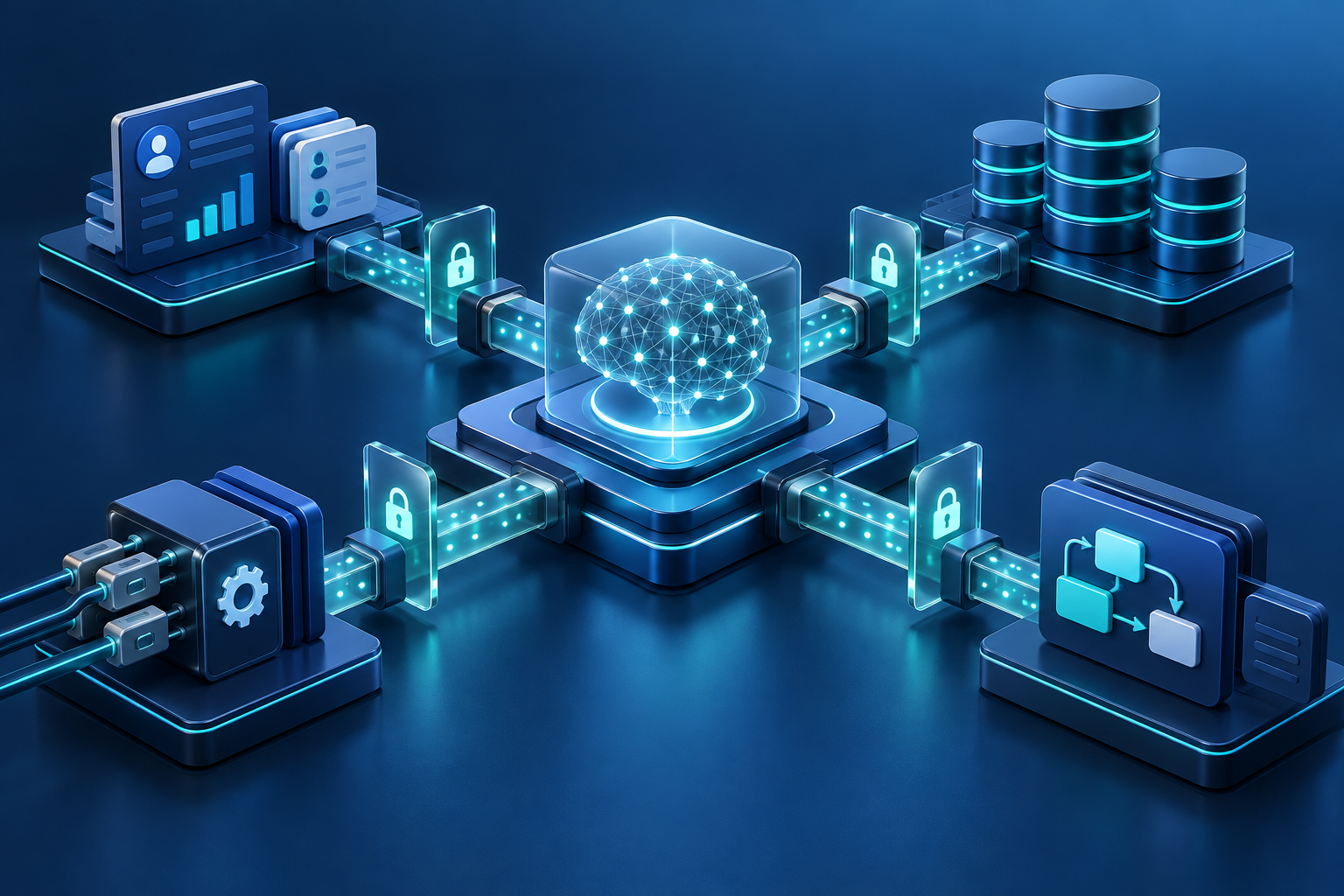
AI integration services connect a model or agent to the systems where business work actually happens. The strongest implementations keep the model inside an application boundary that controls identity, data access, tool contracts, validation, approvals, retries, and audit evidence. The goal is not to expose every API to a model. It is to make one useful workflow safer and easier to operate.
Which business systems are usually connected?
- CRM and customer-success records for account research or routing.
- Support and service-desk systems for triage, summaries, and handoffs.
- Knowledge stores for retrieval and grounded responses.
- Data warehouses and analytics systems for controlled reporting.
- Operational APIs for approved, reviewable actions.
How should an AI integration be scoped?
Start with one workflow and write down its trigger, data sources, decision, system of record, side effects, and exception owner. Use the minimum fields required for the task. Keep tenant and role checks close to the data access layer, and separate recommendations from actions that change durable records.
What makes an integration reliable?
Use typed request and response contracts, schema validation, timeouts, bounded retries, idempotency keys, and clear pending or rejected states. Treat downstream APIs as changeable dependencies. Log the actor, tool, policy decision, and result while minimizing sensitive payloads. A human approval step should show the proposed change and the evidence behind it.
How should an integration be evaluated?
Build cases from ordinary requests and failure modes such as stale records, conflicting data, denied permissions, duplicate events, provider timeouts, and unsupported actions. Measure task completion, grounded context, correct tool selection, policy adherence, escalation quality, latency, and cost. Keep regression cases when the model, prompt, data, or API contract changes.
What should you ask an AI integration partner?
Ask how the partner handles identity, secrets, data minimization, permissions, failure recovery, observability, testing, ownership, and handoff. DeepVention Labs provides production AI agent integration for teams that need a reviewable path from a business workflow to a maintained system.
Build an LLM GTM system around this topic.
Explore strategy, GEO content, proof architecture, distribution, automation, and visibility measurement.