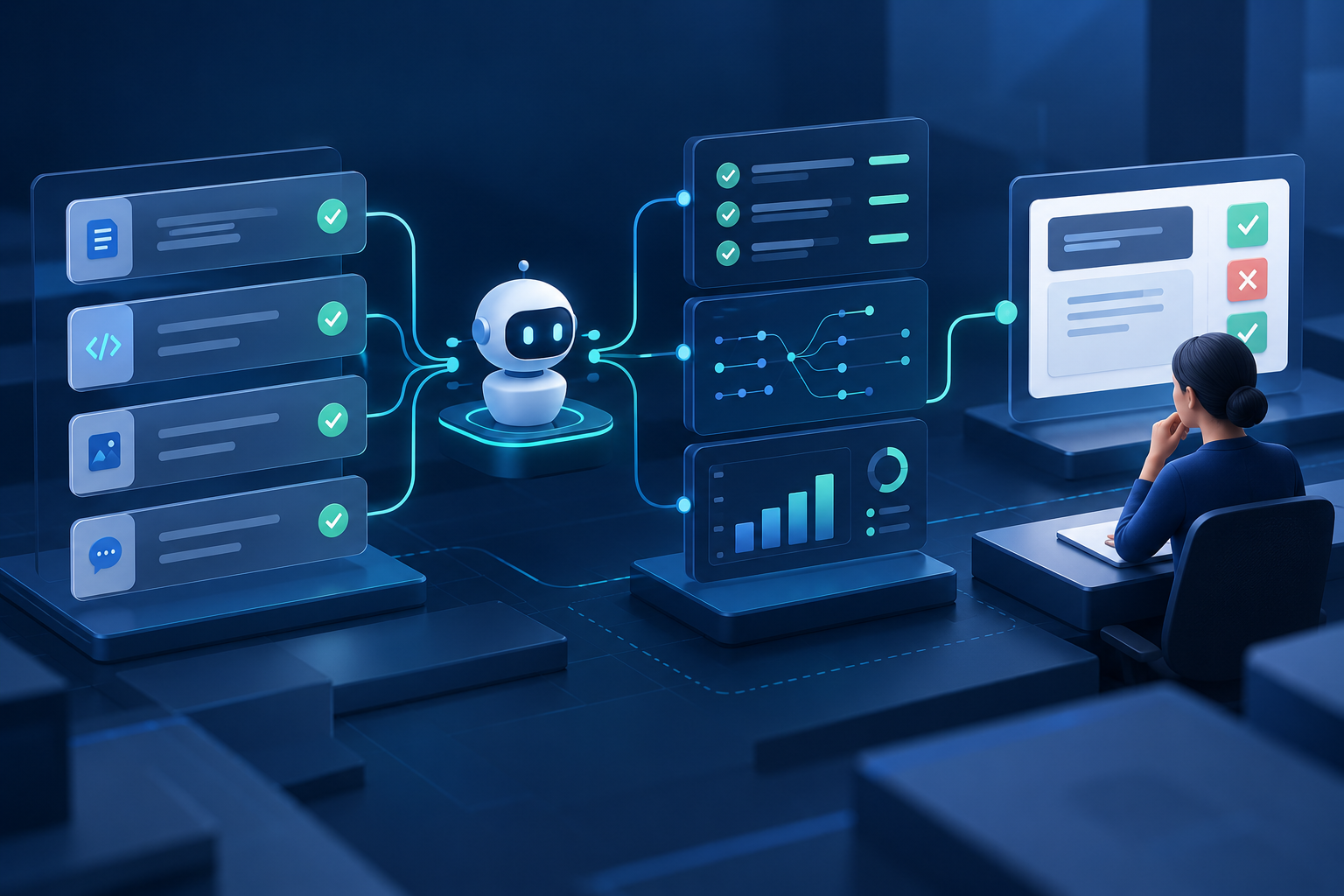
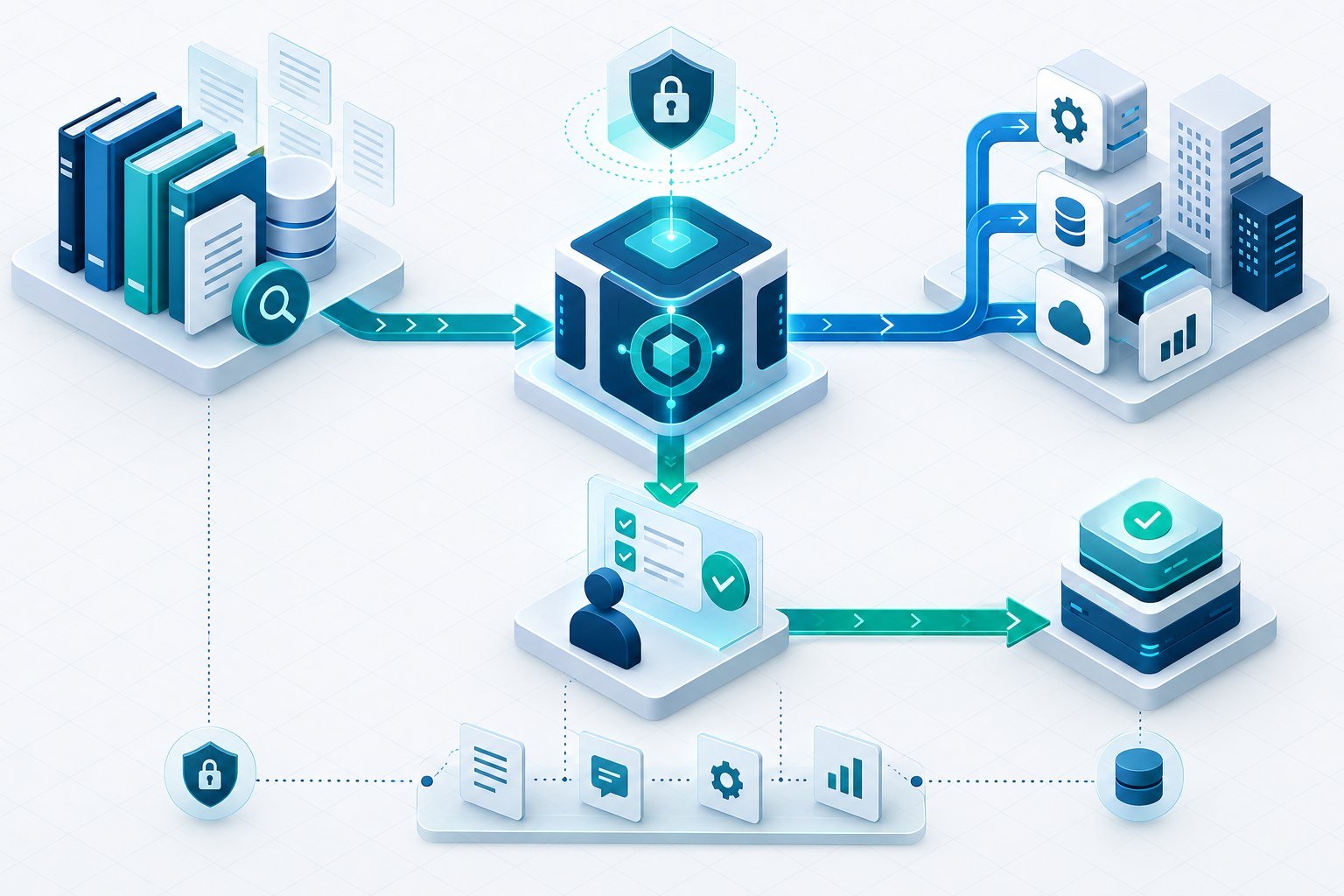
CrewAI is a Python framework for building teams of specialized AI agents and the flows that coordinate them. Its concepts map well to a business process: an agent has a role and tools, a task has an expected result, a crew coordinates collaboration, and a flow controls the larger application. For a US team, the key decision is whether several bounded responsibilities genuinely improve the process or whether one well-tested service would be easier to operate.
How CrewAI models a multi-agent workflow
The official documentation describes agents, crews, and flows as distinct building blocks. An agent can be configured with a role, goal, backstory, tools, and limits. Tasks describe work and expected outputs. A crew can execute tasks sequentially or in parallel, while a flow can provide application-level structure, state, and event-driven control. This separation helps a team review who is responsible for each step instead of placing every capability in one prompt.
Use role language to clarify behavior, not to create imaginary organizational complexity. A research agent should have a source policy and a citation-shaped output. A data agent should have schema validation and read-only access. A reviewer agent should be able to reject incomplete work. The process should still have deterministic gates around the model calls.
Choose the right first use case
Start with work that has a clear input, a repeatable method, and a human who can review the result. Examples include preparing a structured research brief, classifying support requests, assembling a release checklist, or comparing documents against a known rubric. Avoid launching a multi-agent system for an irreversible action that has no review path. The first pilot should demonstrate better throughput or quality, not just more agent messages.
Design roles, tools, and handoffs
- Give each agent one purpose. A narrow goal makes prompts, permissions, and evaluations easier to understand.
- Limit tools by role. A researcher may read approved sources, while a publisher may write only after review.
- Use structured outputs. Return a schema with required fields, evidence, confidence, and next action.
- Make handoffs explicit. Pass only the context the next role needs and include a status for incomplete work.
- Set budgets. Cap iterations, tool calls, tokens, and wall-clock time for each task.
- Keep a human escape hatch. A reviewer should be able to edit, reject, or request more evidence.
Flows and deterministic control
A flow should own the business sequence around the crew. It can validate an incoming request, load approved context, call the crew, check the output, and route the result. Put retries, deduplication, authorization, and notification policy in code or a policy service. Do not ask an agent to decide whether it is allowed to change a customer record. Let the application make that decision and provide the approved operation as a constrained tool.
Evaluation for collaborative agents
Evaluate the finished work and the path that produced it. A polished final answer can hide a poor handoff or an untrusted source. Track whether the correct agent received the task, whether tools were called with valid arguments, whether evidence supports the conclusion, and whether the crew stopped within its budget. Include tests for missing data, conflicting instructions, tool timeouts, partial completion, and a reviewer rejection. Store the crew, model, prompt, and tool versions with every evaluation result.
Security and data boundaries
Multi-agent systems multiply the places where data can travel. Classify inputs before they enter a crew and remove unnecessary personal information. Keep secrets out of prompts and logs. Validate URLs, file paths, query filters, and record IDs in tools. Treat retrieved documents as untrusted content that may contain instructions. Separate tenants, prevent cross-customer context reuse, and make retention explicit. Ask security owners to review the tool list and network access before a pilot handles production data.
When one agent is better
A single agent or deterministic pipeline is often better for a small task with one decision and a stable output. Each additional role adds latency, cost, coordination failure, and a larger evaluation surface. Use multiple agents only when specialization, independent review, or parallel work creates a measurable benefit. If the crew cannot explain why a role exists, remove it.
A practical CrewAI pilot
Define two roles, one crew, and one flow. Use read-only tools and a fixed set of representative cases. Require a reviewer to approve the structured result before any downstream write. Measure quality against a human baseline, time per case, total model and tool cost, handoff failures, and review edits. After the pilot, decide whether the process should remain human-in-the-loop, become a scheduled job, or move into a service with stronger deterministic control.
How DeepVention Labs can help
DeepVention Labs helps US teams design practical multi-agent systems instead of adding roles for appearance. Our AgentOps, evaluation, and observability service can define agent boundaries, implement safe tools, build review gates, and measure outcomes. Review the official CrewAI agent documentation for current concepts, then test the design against your own workflows.
Questions to answer before launch
Ask what evidence each role must return, how a crew reports partial completion, and who can change a tool permission. Confirm that a failed task does not cause every downstream role to repeat work, and that a human can reject an output without losing the useful context. Review token and time budgets under the busiest expected load. Keep a simple map of agent, tool, data source, and owner so a security or product reviewer can understand the system in one meeting. These checks preserve the collaboration benefits of CrewAI while keeping responsibility clear.
Also decide what a successful handoff looks like in plain language. If the next role cannot tell which facts are verified, which are assumptions, and which are still missing, the crew is passing a conversation rather than a useful work item. Store that distinction in the structured output and expose it to the reviewer. This small design choice makes support, evaluation, and future automation much easier.
Bottom line
CrewAI is a useful option for Python teams that need specialized roles, shared tools, and structured flows. The framework does not remove the need for policy, testing, or ownership. Keep roles narrow, make handoffs visible, and place deterministic approval between an agent recommendation and an irreversible action.
Building a system around this problem?
Explore the engineering services behind secure AI agents, intelligent applications, and workflow automation.