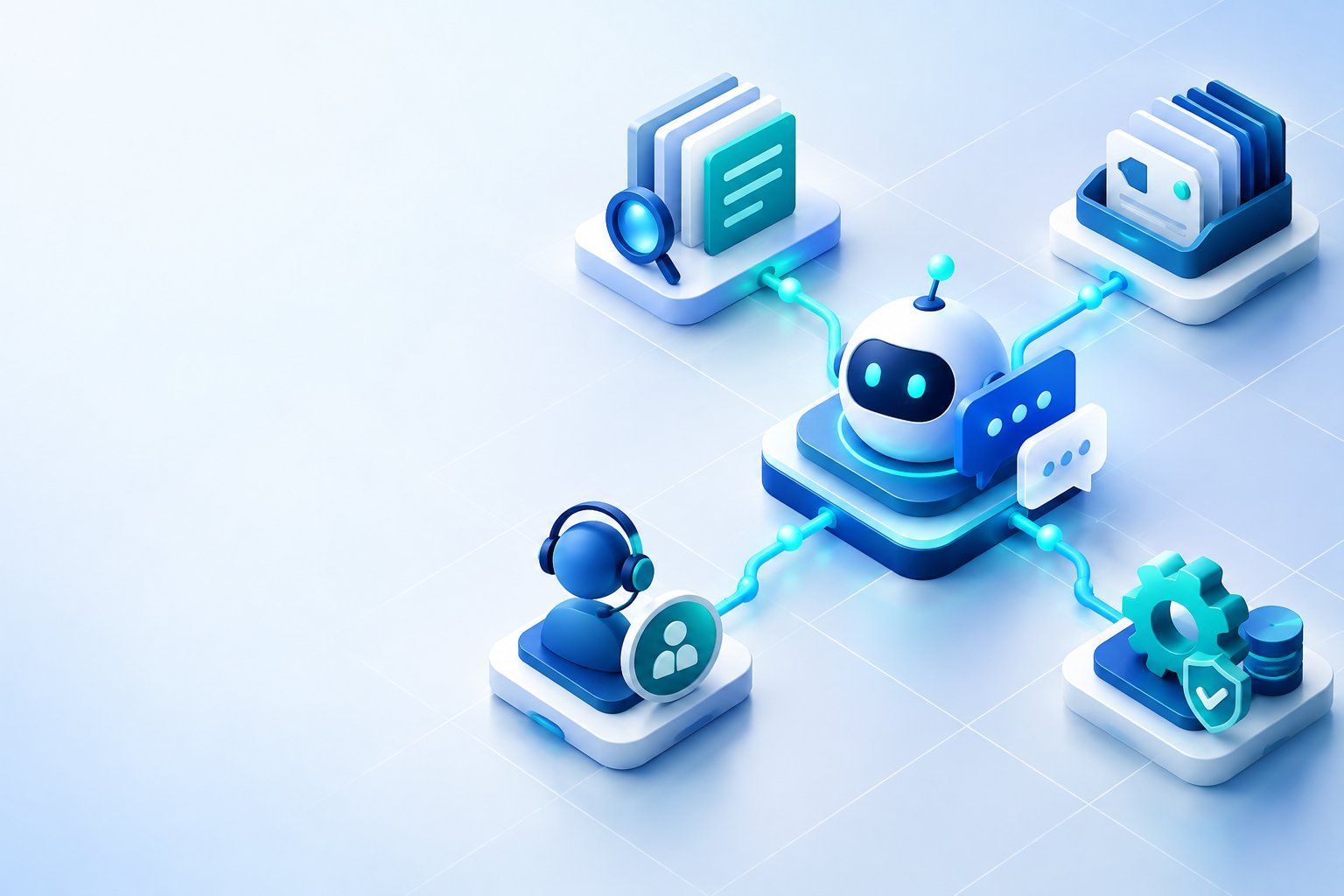
AI customer support automation should reduce repetitive work while making uncertainty visible. A production workflow can classify an incoming request, retrieve approved account or product context, draft a response, route the case, and suggest the next action. It should not quietly invent policy, expose another customer’s data, or execute a high-impact change without the required authorization.
What to automate first
- Triage: Identify topic, urgency, language, customer tier, and routing destination.
- Knowledge retrieval: Find relevant product or policy information from approved sources.
- Drafting: Prepare a response that a support specialist can review and edit.
- Case summaries: Condense a long thread into facts, attempted steps, and unresolved questions.
- Workflow routing: Create a task or escalation only when the application confirms the required conditions.
Keep the answer grounded
Support automation should separate retrieved evidence from generated language. Show the source or policy reference when a specialist needs to verify the answer. If the system cannot find a current source, it should say that it needs review instead of filling the gap with a confident guess. Product changes and customer-specific permissions make stale context a real operational risk.
Protect customer data and actions
Enforce access at the system boundary, not only in the conversation. Limit retrieval by customer, tenant, role, and support purpose. Keep read tools separate from write tools. Password resets, refunds, account changes, and other consequential actions should use explicit policy checks and a review state when the risk requires it.
Evaluate real support behavior
Test ordinary questions alongside incomplete requests, angry language, contradictory records, unsupported product claims, prompt injection, unavailable systems, and sensitive-data requests. Measure correct routing, grounded answers, escalation quality, policy adherence, resolution support, latency, and cost. Review both successful and blocked runs so the team can see where the workflow needs a better source, rule, or interface.
Roll out with a visible human path
Begin with internal summaries and draft responses, then expand to customer-facing assistance as the evaluation evidence improves. Make escalation easy and preserve the conversation context for the human who receives it. DeepVention Labs supports production AI agent integration with retrieval, tool authorization, evaluation, observability, and controlled handoffs.
Build an LLM GTM system around this topic.
Explore strategy, GEO content, proof architecture, distribution, automation, and visibility measurement.