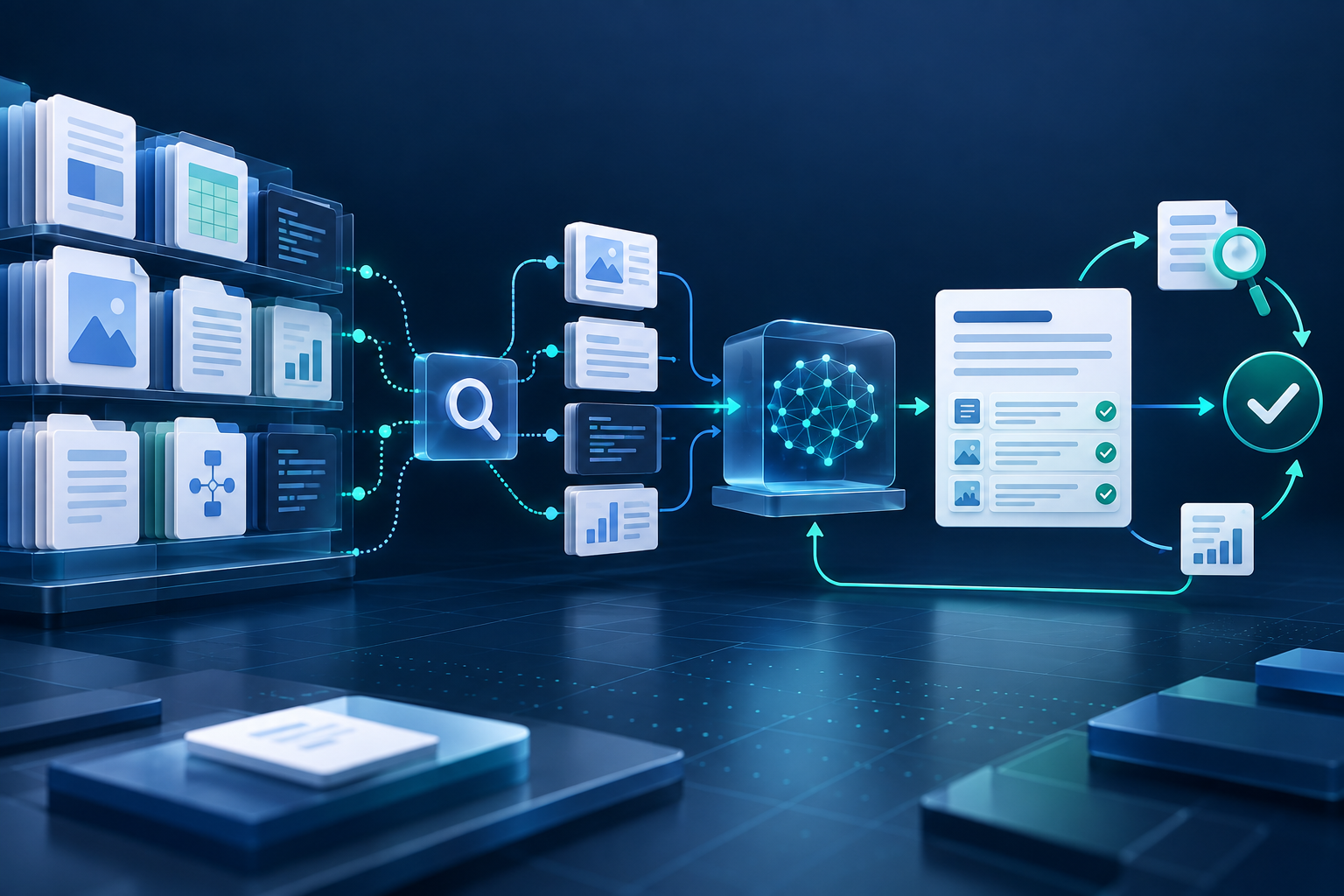
RAG evaluation measures whether a retrieval augmented generation system finds the right evidence and uses it accurately. A fluent answer is not enough. Teams should test retrieval relevance, context coverage, grounded claims, answer completeness, refusal behavior, latency, and cost against representative questions and known source documents.
What are the two parts of a RAG evaluation?
Evaluate retrieval and generation separately before scoring the end-to-end answer. Retrieval tests ask whether the correct documents or passages were returned in a useful order. Generation tests ask whether the response stays supported by that context, answers the question, and identifies uncertainty when the evidence is incomplete.
Which test cases should a RAG system include?
- Questions whose answers are present in one authoritative document.
- Questions that require combining multiple sources.
- Ambiguous questions that need clarification.
- Questions where the answer is absent and the system should abstain.
- Conflicting or outdated documents that require a source-priority rule.
- Permission-sensitive questions where retrieval must respect the user or tenant.
How do you score grounded answers?
Use a rubric that checks claim support, citation or source alignment, completeness, and clarity. Compare each material claim with the retrieved evidence. A response can be relevant but unsupported, supported but incomplete, or accurate but too vague to guide the user. Keep human review for a sample of cases so automated graders do not become the only authority.
What changes require a new RAG evaluation?
Re-run the evaluation when the embedding model, chunking, filters, reranker, source corpus, prompt, model, or permission logic changes. Also sample production questions because user language, document freshness, and access patterns evolve. The Azure RAG evaluator sample illustrates how a repeatable evaluation harness can fit into an engineering workflow.
How can a team improve a weak RAG result?
Fix the narrowest failure first. Improve source ownership and freshness when evidence is missing, adjust chunking when context is incomplete, tune retrieval when relevant passages are buried, and tighten the answer policy when claims exceed the evidence. DeepVention Labs builds evaluated knowledge systems that connect retrieval quality to production decisions.
Build an LLM GTM system around this topic.
Explore strategy, GEO content, proof architecture, distribution, automation, and visibility measurement.